When a storm rips through your neighborhood at 2 a.m., the difference between a long, expensive recovery and a steady, safe return to normal often comes down to who shows up and how they work. Storm damage cleanup is not just hauling brush. It is shoring up roofs in the dark, reading stressed wood and twisted rigging, coordinating with utilities, and making judgment calls that keep people safe. I have seen homeowners try to muscle a snapped limb off a porch with a pickup and strap. The truck won, the strap slipped, and the limb gashed the siding, then swung into a window. The cost of a proper emergency tree service would have been a fraction of the repairs.
In the Akron area, weather is rarely gentle for long. We live with freeze-thaw cycles that heave roots, late snowfalls that load canopies, and summer squalls that push microbursts across mature neighborhoods. When you need a 24/7 response, you want someone who understands both the physics of trees under stress and the practical realities of your street, your roof pitch, and your insurer.
What storms really do to trees, and why it matters for safety
Every windstorm has a fingerprint. Straight-line winds turn crowns into sails and pry at the root plate. Heavy, wet snow packs on flat-topped maples and younger oaks, causing compression failures where fibers crush on the top of a limb and tear on the underside. Ice storms are the quiet menace. A quarter inch of glaze can add hundreds of pounds to a canopy, and I have watched sugar maples that looked fine at dusk start shedding leaders at midnight as the temperature fell and the ice stiffened.
Damage is rarely obvious from the ground. I have cut a limb that looked stable only to hear the hiss of fibers and feel movement telegraphed through the saw. Hidden splits, twisted grain and unbalanced loads turn a simple cut into a lever waiting to spring. In storm conditions, wood behaves differently, and gravity is not the only force in the equation. Tension and compression run through a downed trunk like loaded springs. One wrong kerf can release that energy into a whipping butt log or a kicked bar.
That is why professional tree removal after a storm is not the same as routine pruning on a calm day. It is also why a responsible crew will look slow at first. The first twenty minutes often belong to assessment and stabilization, not cutting.
The first hour after a tree hits your house
Homeowners can do a few specific things that preserve safety and make the next steps smoother. Think of it as a short runway before help arrives.
- Confirm that everyone is safe, then turn off utilities if you suspect damage. If a tree has contacted service lines or the mast on your roof, treat it as energized and keep everyone at least 30 feet away. If you smell gas, leave the property and call the utility from a safe distance. Document the scene with photos and short videos from multiple angles, including interior damage if it is safe to enter. This speeds insurance and helps the crew plan before they arrive. Protect what you can without entering danger zones. Place buckets under active drips, move valuables away from leaking ceilings, and cover items with plastic sheeting if you have it. Call a 24/7 tree service and your insurer. Give clear details: location, tree species if known, where it is resting, and any utility involvement. Ask for estimated arrival and whether they are coordinating with the power company. Keep the driveway clear for trucks and cranes. Move vehicles if it is safe to do so. Access is often the difference between a two-hour and a ten-hour job.
If you are in Summit County or nearby, a reputable tree service Akron outfit will be accustomed to these calls. On big weather nights, dispatchers triage by risk: structures and wires first, blocked roads second, then property damage that is not life-safety related. A straightforward downed limb can wait until daylight. A trunk speared through a roof ridge or a hung leader over a children’s room moves to the top of the list.
What 24/7 emergency really means in practice
Round-the-clock service is not a slogan. It takes logistics. Crews rotate on-call, trucks stay fueled, and gear is packed for wet work: headlamps with extra batteries, tarps, temporary roof jacks, non-slip mats, and winter-rated bar oil. On a typical storm-night mobilization, you will see a foreman’s pickup arrive first for hazard assessment and to coordinate with police or the utility if lines are involved. The chip truck and aerial lift or crane follow as access and safety allow.
Time estimates depend on complexity and weather. In Akron, a crew can often reach urban addresses within one to two hours of a call during off-peak events. Region-wide ice or wind will stretch that window. The company you choose should set realistic expectations. If they promise every caller a 30-minute response during a countywide outage, that is a red flag. Better to hear, “We can get a foreman there in 90 minutes to secure the scene, and the full crew will follow within two to four hours.”
Stabilizing the scene before the first cut
A disciplined team treats a storm site like an incident command. They identify hazards, set a work zone, and make the area predictable. The process looks simple from the curb and complicated when you are on the roof in sleet.
- Utilities take precedence. If the tree has compromised the service mast or lines are draped in the canopy, we coordinate with FirstEnergy/Ohio Edison. Tree crews do not touch energized lines. We can often set rigging around a hazard to free trapped lines after the utility de-energizes or isolates the service, but we do not guess. Structural support comes next. If a trunk is resting on a ridge or hip, we may build cribbing stacks under the load to prevent further collapse as weight shifts. Sometimes a small upward lift with a knuckle-boom or crane relieves pressure enough to make safe cuts. On one job near Highland Square, cribbing bought time when ice made the roof un-walkable. A careful lift spared the plaster ceilings below. Access is cleared only as needed. Speed matters, but we do not waste time turning the entire yard into a staging area if we can cut and lift from a narrow lane. Ground protection mats go down quickly to preserve turf and avoid bogging trucks on saturated soil. Akron clay holds water; heavy gear sinks fast after a thaw.
These steps take patience, but they shorten the job. A site under control lets sawyers focus on fiber behavior instead of tiptoeing around loose debris and guesswork.
How pros remove a tree from a roof without adding damage
The goal is to reduce force on the structure while maintaining control of each piece. In the field, I rely on three broad approaches, selected to match the tree’s position, the roof’s condition, and available equipment.
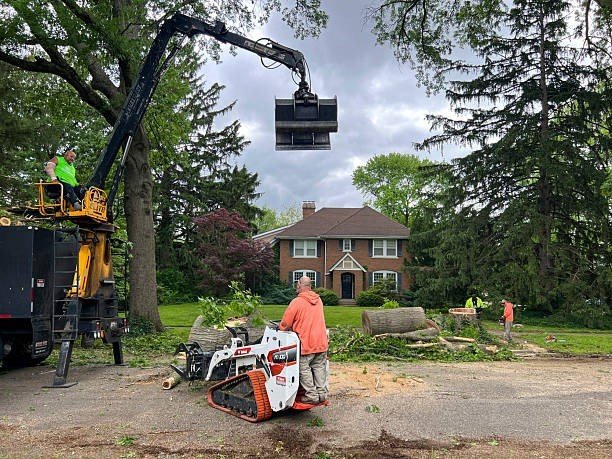
- Rigging and piecemeal takedown from an aerial lift: If the tree is small to medium and reachable, an arborist in a bucket ties off sections with rated rope, then makes precision cuts so ground crew can lower each piece clear of the roof. This works best when the roof can bear light foot traffic or when the bucket provides full access. Cuts favor bypasses that relieve tension gradually, not snap cuts that send a shock through rafters. Crane-assisted removal: When a trunk spans a house or the canopy is tangled and loaded, a crane is the cleanest option. The operator sets slings in the canopy, tensions the pick to neutralize weight, and the sawyer makes a release cut. The crane swings the section to a drop zone, where it is processed. With a good operator and spotter, we keep pieces completely off the structure. I have cleared a 60-foot red oak from a bungalow in Ellet in three hours this way, leaving only two shingle scuffs that the roofer addressed the next day. Ground-based winching and cribbing: In tight alleys or steep lots where a crane cannot get close, we build crib stacks and use a portable capstan winch to shift weight. It is slower but safer than prying with a peavey. This method shines on small homes with delicate roofs, where even light vibration could loosen old lath and plaster.
Every technique is anchored in reading the wood. Torn fibers can hide like a crack under paint. If a limb has failed in torsion, grain can steer a saw into a bind. Crews watch kerfs and listen for change in pitch. They pre-plan escape routes and never stand in the bite of a rope under load. Storm work rewards humility.
When removal is not the only answer
Total tree removal is not always necessary. A big limb snapped in a storm can be a cue to reevaluate, not a mandate to fell the whole tree. A healthy oak with a single broken leader may respond well to a crown reduction and a new dominant leader trained over a few seasons. A co-dominant maple with a narrow union might benefit from a through-bolt and cabling to reduce future risk. I have suggested corrective pruning and structural support for many trees in Akron’s older neighborhoods, where large canopies are part of the street’s character. The savings are real. Removing a mature tree can cost three to five times more than staged pruning over three years, not counting the value of shade and curb appeal.
That said, there are clear cases where removal is the responsible choice. A trunk split more than a third of the diameter below the crown union, widespread decay in the root flare, or a tree that has heaved and not re-seated in the soil after a wind event are all signals. The presence of fungal fruiting bodies at the base can be a bigger concern than a few torn limbs. A trustworthy arborist will show you the evidence and talk through options. If they push removal without explanation, ask questions.
If removal is required, storm damage cleanup often includes stump griding to finish the job. Grinding to a depth of 6 to 12 inches is typical for lawn restoration. Deeper grinding may be needed near sidewalks or for replanting. Chips are raked smooth unless you request haul away, and loam and seed can be added as a separate line item. In Akron, many clients prefer a spring reseed after a winter grind so frost heave does not undo the work.
The difference a local team makes
Tree service Akron companies work in a specific context. Neighborhoods like Firestone Park and West Akron have tight drives and mature street trees with limited front-yard staging. Lake-effect snow and freeze-thaw cycles are harder on silver maples and Bradford pears that already have weak branch unions. The emerald ash borer left a trail of standing dead that look solid from the curb but break unpredictably under load. Crews who know these patterns make better calls on night jobs.
Local crews also know the permitting and utility landscape. The City of Akron Urban Forestry Division and adjacent townships have their own rules for right-of-way trees. Some removals on the tree lawn require permits or coordination with public works. After storms, lines across yards are often the jurisdiction of the homeowner’s utility drop, but primary lines in alleys are not. A seasoned foreman knows when to wait for a utility clearance and who to call to speed that up.
Working with insurance without losing your weekend
Storm damage cleanup touches insurance in two places: emergency mitigation and permanent repair. Most homeowner’s policies cover reasonable costs to remove a tree from a covered structure and to prevent further damage. They also usually cover temporary measures like tarping a roof. Removing the remaining tree debris from your yard is sometimes covered and sometimes not, depending on the policy language and what the tree hit.
Good communication simplifies everything. A professional tree removal Akron provider should produce a written estimate with clear scope: remove elm trunk from roof without additional damage, crane-assisted; chip brush and haul off; cut trunk to fireplace lengths stacked by garage; grind stump 10 inches below grade; install 20 by 30 foot roof tarp with 2 by 4 battens. They should also document the site before, during and after with photos that you or your adjuster can reference. I have seen claims pay out faster when we send a brief after-action summary the same day: time on site, crew size, equipment used, unique hazards, and why we chose a particular approach.
Expect to pay the emergency portion out of pocket and be reimbursed, although some insurers will pay the contractor directly. If there is a deductible, it applies to the total claim. For non-emergency cleanup and stump griding, you may prefer to wait for adjuster approval before proceeding, unless safety argues otherwise.
What it really costs, and why
Honest ranges help you plan. Prices vary with access, size, hazard, and timing.
- Removing a medium limb from a roof at night with a two-person crew and an aerial lift often falls in the $600 to $1,800 range. Crane-assisted removal of a large trunk spanning a house, with street permits and a five to six person crew, can run $2,500 to $8,000. Complex picks on tight streets with extra rigging push higher. Stump griding typically ranges from $150 for a small stump to $600 or more for large diameters or root-choked sites. Hauling chips and backfilling with soil adds cost. Whole-yard storm damage cleanup after a severe event, where multiple trees are down, can range widely. I have billed $1,200 on the low end for a half day with chipper and crew and north of $10,000 when heavy equipment and multiple days were required.
Any reputable tree service will explain what drives the price. Overnight mobilization, crane rental, and utility coordination are real costs. The flip side is that experienced crews reduce secondary damage. I have watched a DIY cut buckle a ridge, turning a $2,500 crane job into a $15,000 roofing and drywall repair. Cheap can be expensive.
How to vet an emergency tree service when the chips are down
You do not have time for a week of research while rain is dripping into the kitchen. Still, a quick filter in the first phone call can separate professionals from opportunists.
- Ask if they carry liability insurance and workers’ compensation, and request a certificate by email. A refusal is a deal-breaker. Confirm 24/7 availability with actual crews, not just a voicemail service. Ask for tonight’s estimated response time and how they triage jobs. Listen for specificity. A pro will ask about tree size, species, contact points on the structure, utilities, and access. Vague promises signal inexperience. Ask what equipment they expect to use. Hearing “we will show up with a chainsaw and see” is not comforting. A crew that mentions an aerial lift, ground protection mats, cribbing, and rigging gear is thinking ahead. Request references or recent storm photos. Even one or two examples help you gauge competence.
If you want a truly local partner, search for tree service Akron companies with ISA Certified Arborists on staff and a track record in your neighborhood. Look for memberships in professional groups, but value clear communication and documented work more than badges.
Preventive care before the next storm
The cheapest emergency is the one you avoid. Pre-storm inspections flag the common failure points long before the radar turns red.
I walk clients around their property and look low first. Girdling roots at the base, fungal conks on the trunk, and soft spots at the root flare are more worrisome than a dead twig in the crown. Co-dominant stems with a tight V-shaped union are frequent storm casualties. They can be managed with reduction cuts to reduce sail area, through-bolts that reinforce the union, and, in some cases, dynamic cabling. Over-extended limbs that stretch over roofs collect snow and ice and yank with leverage. Reducing the end-weight and thinning selectively shifts the balance back toward the trunk.
Young trees handle pruning well, and structural training in the first 10 years saves you from crane work later. For older trees, prudence matters. Do not over-thin. A healthy crown needs leaves to feed the root system, and aggressive cuts can spur weak water sprouts.
Site conditions count too. Poor drainage around the root zone softens the ground, making wind-throw more likely. Mulch properly, two to three inches deep, pulled back from the bark, and avoid piling soil over tree service roots during landscape projects. If you are planning a patio, consult before excavation. I have seen well-meant hardscaping suffocate roots on the compression side of an oak, turning a solid tree into a storm risk three years later.
What to expect from a full-service follow through
Storm nights are only half the story. A company you trust will return in daylight to review the site, tidy the work area, and plan the remaining tasks. That might include completing tree removal of compromised specimens, scheduling stump griding, and restoring lawns where heavy equipment sat.
They will also debrief what they saw. I like to pull up the photos we took and show homeowners the hidden cracks and stress points. It turns a scary night into a learning moment. You see why your silver maple shed the branch that it did, and what steps can reduce the odds next time. It is also the right time to talk about replacements. If an ash finally came down after years of decline, we can recommend species that suit your soil and light. In Akron, swamp white oak, Kentucky coffeetree, or disease-resistant elm cultivars do well in many yards.
The role of communication when everything feels urgent
Storm damage tests patience. You hear the drip, the forecast calls for more rain, and your phone is at 6 percent battery. The best crews know how much that weighs on you. They show up with a plan, tell you what will happen in the next hour, and keep you updated when conditions change. If the crane is delayed by a downed line on Exchange Street, they will tell you and secure your roof with a tarp and battens to buy time. If the neighbor’s tree is now resting on your fence, they will help you coordinate who is responsible for which cost, and document accordingly.
Clear communication also protects the crew. When everyone understands the plan, tools stay where they need to be, hand signals stay consistent, and the work moves faster. Night jobs are about trust on both sides of the saw.
A word on debris, disposal, and what becomes of your tree
After the main event, you will have questions about the mess. Brush typically gets chipped on site. Logs are bucked to manageable lengths and either hauled for milling or firewood, depending on species, size, and demand. I have sent straight oak stems from West Akron to a small sawmill that turns them into tabletops. Diseased wood like ash with advanced decay generally heads to a disposal site. If you want to keep logs for your own firewood, say so early. Wet storm wood needs seasoning. A fresh red oak round will not heat your home this winter.
Chips can be left in a neat pile or hauled away. If you plan to use them, set them aside for paths or as a weed barrier, not directly against house foundations. Fresh chips pull nitrogen as they break down, so they are not ideal as immediate garden mulch without composting.
Why the words you choose online matter when you need help fast
When you search for help at midnight, use terms that reflect what you need. Tree removal Akron will surface crews with crane capacity and emergency skills. Tree service pulls a wider net that includes pruning, plant health care, and routine maintenance, which is valuable once the crisis passes. If you need the stump gone too, include stump griding in the conversation. Not every company grinds, and scheduling that with the same outfit can save a trip fee.
Storm damage cleanup is the umbrella term that covers all of it. You want someone who can stabilize tonight, remove safely, document for insurance, and return to finish, not a one-and-done cut-and-run.
A final perspective from the roofline
I have stood on roofs in sleet with a 200-pound limb suspended over my head and a homeowner watching from the window, eyes wide, hands wrapped around a mug. In those moments, skill counts, but so does calm. The work is physical and technical, and it is also service. You called because the night took a turn. Our job is to meet it with judgment, good tools, and a plan that leaves your home better than we found it.
If you are in or around Akron and need immediate help, look for a tree service Akron team that answers the phone at odd hours, talks specifics, and shows up with the right gear. If they can explain how they will protect your roof, coordinate with utilities, and handle the follow-through from tree removal to stump griding, you are on the right path. Storms will come again. With the right partner, the aftermath does not have to be chaos.
Address: 159 S Main St Ste 165, Akron, OH 44308
Phone: (234) 413-1559
Website: https://akrontreecare.com/
Hours:
Monday: Open 24 hours
Tuesday: Open 24 hours
Wednesday: Open 24 hours
Thursday: Open 24 hours
Friday: Open 24 hours
Saturday: Open 24 hours
Sunday: Open 24 hours
Open-location code: 3FJJ+8H Akron, Ohio Map/listing URL: https://www.google.com/maps/place/Red+Wolf+Tree+Service/@41.0808118,-81.5211807,16z/data=!3m1!4b1!4m6!3m5!1s0x8830d7006191b63b:0xa505228cac054deb!8m2!3d41.0808078!4d-81.5186058!16s%2Fg%2F11yydy8lbt
Embed:
https://akrontreecare.com/
Red Wolf Tree Service provides tree removal, tree trimming, stump grinding, storm cleanup, and emergency tree service for property owners in Akron, Ohio.
The company works with homeowners and commercial property managers who need safe, dependable tree care and clear communication from start to finish.
Its stated service area centers on Akron, with local familiarity that helps the team respond to residential lots, wooded properties, and urgent storm-related issues throughout the area.
Customers looking for help with hazardous limbs, unwanted trees, storm debris, or overgrown branches can contact Red Wolf Tree Service at (234) 413-1559 or visit https://akrontreecare.com/.
The business presents itself as a licensed and insured local tree service provider focused on safe workmanship and reliable results.
For visitors comparing local providers, the business also has a public map listing tied to its Akron address on South Main Street.
Whether the job involves routine trimming or urgent cleanup after severe weather, the company’s website highlights practical tree care designed to protect homes, yards, and access areas.
Red Wolf Tree Service is positioned as an Akron-based option for people who want year-round tree care support from a local crew serving the surrounding community.
Popular Questions About Red Wolf Tree Service
What services does Red Wolf Tree Service offer?
Red Wolf Tree Service lists tree removal, tree trimming and pruning, stump grinding and removal, emergency tree services, and storm damage cleanup on its website.
Where is Red Wolf Tree Service located?
The business lists its address as 159 S Main St Ste 165, Akron, OH 44308.
What areas does Red Wolf Tree Service serve?
The website highlights Akron, Ohio as its service area and describes service for local residential and commercial properties in and around Akron.
Is Red Wolf Tree Service available for emergency work?
Yes. The company’s website specifically lists emergency tree services and storm damage cleanup among its core offerings.
Does Red Wolf Tree Service handle stump removal?
Yes. The website includes stump grinding and removal as one of its main tree care services.
Are the business hours listed publicly?
Yes. The homepage shows the business as open 24/7.
How can I contact Red Wolf Tree Service?
Call (234) 413-1559, visit https://akrontreecare.com/.
Landmarks Near Akron, OH
Lock 3 Park – A well-known downtown Akron gathering place on South Main Street with year-round events and easy visibility for nearby service calls. If your property is near Lock 3, Red Wolf Tree Service can be reached at (234) 413-1559 for local tree care support.
Ohio & Erie Canal Towpath Trail (Downtown Akron access) – The Towpath connects downtown Akron to regional trails and green space, making it a useful reference point for nearby neighborhoods and properties. For tree service near the Towpath corridor, visit https://akrontreecare.com/.
Akron Civic Theatre – This major downtown venue sits next to Lock 3 and helps identify the central Akron area the business serves. If your property is nearby, you can contact Red Wolf Tree Service for trimming, removal, or storm cleanup.
Akron Art Museum – Located at 1 South High Street in downtown Akron, the museum is another practical reference point for nearby residential and commercial service needs. Call ahead if you need tree work near the downtown core.
Stan Hywet Hall & Gardens – One of Akron’s best-known historic destinations, located on North Portage Path. Properties in surrounding neighborhoods can use this landmark when describing service locations.
7 17 Credit Union Park – The Akron RubberDucks’ downtown ballpark at 300 South Main Street is a strong directional landmark for nearby homes and businesses needing tree care. Use it as a reference point when requesting service.
Highland Square – This West Market Street district is a recognizable Akron destination with shops, restaurants, and neighborhood traffic. It is a practical area marker for customers scheduling tree service on Akron’s west side.